Solar installations have transformed South Africa's energy landscape, but the critical role of the solar power transformer often goes unrecognized. This essential component bridges the gap between solar inverter output and grid voltage requirements, ensuring efficient power distribution from photovoltaic arrays to consumption points. Whether you're designing a residential backup system or a commercial-scale solar farm, understanding transformer selection, sizing, and integration determines both system performance and long-term reliability.
Understanding the Solar Power Transformer Function
A solar power transformer serves as the voltage conversion interface between your photovoltaic system and the electrical distribution network. Solar inverters typically output low voltage AC power (230V single-phase or 400V three-phase), which must be stepped up to medium voltage levels (11kV, 22kV, or 33kV) for efficient distribution across larger facilities or grid injection.
The transformer handles this voltage conversion while managing several critical functions simultaneously. It provides electrical isolation between the solar generation equipment and the distribution system, protecting both from fault conditions. Additionally, the solar power transformer must accommodate the unique characteristics of inverter-based generation, including harmonic content and rapid power fluctuations caused by cloud transients.
Key Operational Requirements
Modern solar installations demand transformers engineered specifically for renewable energy applications. Unlike traditional grid transformers designed for steady-state loads, solar power transformers face dynamic operating conditions:
- Variable loading patterns throughout the day as solar irradiance changes
- Harmonic currents generated by inverter switching frequencies
- Reverse power flow when exporting to the grid
- Temperature cycling due to intermittent generation
- Starting inrush from multiple inverters energizing simultaneously
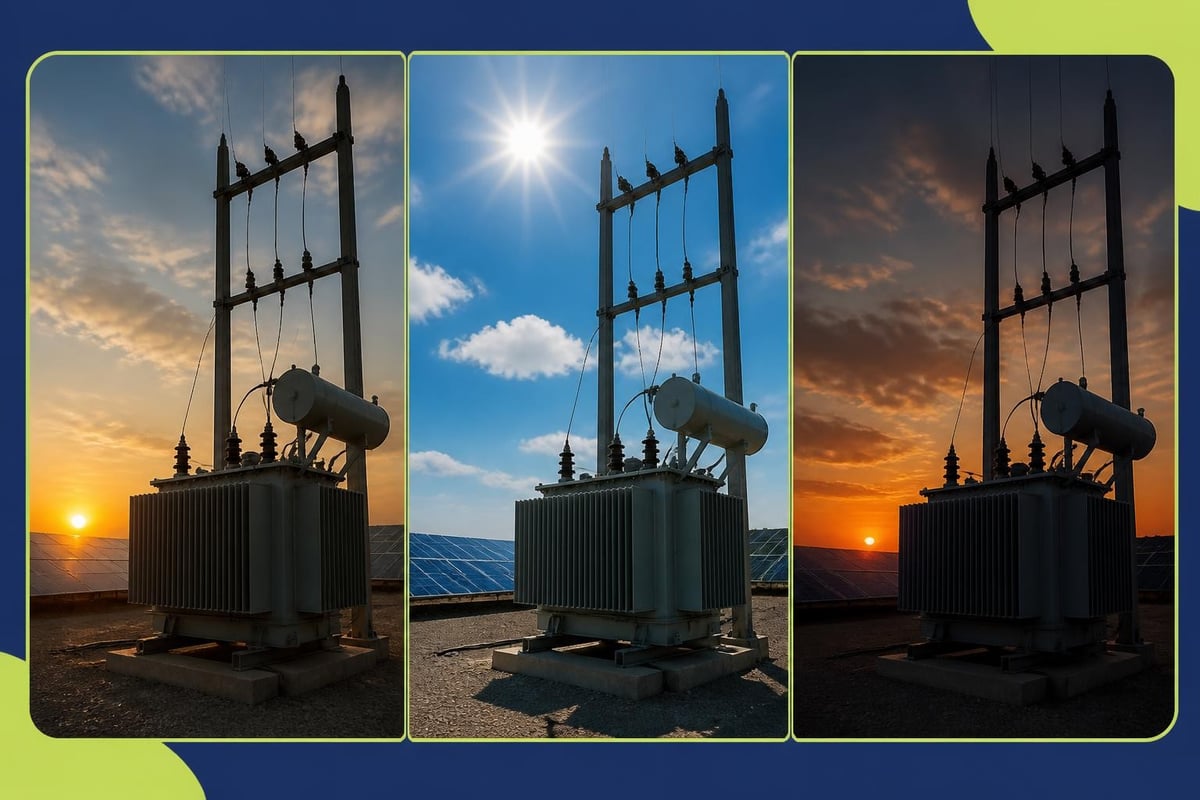
The high-frequency transformer models developed for network studies emphasize the importance of understanding harmonic behavior in inverter-connected systems. These models help engineers predict transformer performance under the switching frequencies typical of solar installations.
Transformer Types for Solar Applications
Selecting the appropriate solar power transformer type depends on installation size, voltage requirements, environmental conditions, and budget constraints. Each transformer technology offers distinct advantages for specific applications.
Oil-Filled Transformers
Oil-immersed transformers remain the dominant choice for medium and large-scale solar installations. The mineral oil provides excellent cooling and insulation, enabling higher power densities and longer service life. These units excel in utility-scale solar farms where space is available and outdoor installation is standard.
Benefits include:
- Superior thermal performance for continuous operation
- Lower initial cost per kVA for larger ratings
- Proven reliability in harsh outdoor environments
- Easy field testing and diagnostic monitoring
However, oil-filled units require careful site planning. Fire protection measures, oil containment systems, and regular maintenance of insulating oil add to operational complexity. The NFPA guidance on transformer installation provides essential fire safety and code compliance requirements for oil-filled solar power transformers.
Dry-Type Transformers
Dry-type transformers use air or resin insulation rather than oil, making them suitable for indoor installations and locations where fire risk must be minimized. Recent advances in dry-type transformer design have improved thermal performance and efficiency, expanding their applicability in solar projects.
| Feature | Oil-Filled | Dry-Type |
|---|---|---|
| Typical Rating Range | 500 kVA – 50 MVA | 15 kVA – 5 MVA |
| Installation Location | Outdoor with containment | Indoor or outdoor |
| Fire Risk | Higher (requires suppression) | Lower (self-extinguishing) |
| Maintenance Frequency | Annual oil testing | Minimal (visual inspection) |
| Efficiency at Full Load | 98.5% – 99.5% | 97.5% – 98.5% |
| Initial Cost per kVA | Lower for large units | Higher overall |
For rooftop commercial installations or facilities with strict environmental requirements, dry-type transformers offer significant advantages despite higher upfront costs. Their minimal maintenance requirements also reduce lifecycle expenses.
Pad-Mount and Compact Designs
Pad-mounted transformers combine oil-filled technology with compact enclosures designed for ground-level installation. These units integrate switchgear and protection in a single tamper-resistant cabinet, ideal for commercial solar installations where aesthetic considerations matter.
The compact design reduces site footprint while providing secure operation. ELECTRICAL4U specializes in medium voltage switchgear and transformer solutions that integrate seamlessly with solar installations, backed by comprehensive maintenance programs.
Sizing Your Solar Power Transformer
Proper transformer sizing balances initial investment with operational efficiency and future expansion capability. Undersizing leads to overheating and shortened lifespan, while oversizing increases losses during light-load periods typical of solar generation.
Calculating Required Capacity
Start with your solar array's total DC rating and inverter specifications. A 1 MW DC solar array with 95% inverter efficiency produces approximately 950 kW AC at peak generation. However, the solar power transformer must be sized considering several additional factors:
- Apply inverter oversizing ratio (typically 1.0 to 1.2)
- Account for future expansion (recommend 20-30% headroom)
- Consider ambient temperature derating for outdoor installations
- Include auxiliary loads (tracking systems, monitoring equipment)
- Verify short-circuit capacity for fault protection coordination
For example, a 950 kW inverter output with 1.15 oversizing factor and 25% expansion margin requires a minimum 1,370 kVA transformer. Standard ratings would indicate a 1,500 kVA or 2,000 kVA unit depending on availability and voltage class.
Optimizing for Solar Generation Profiles
Unlike conventional transformers operating near rated capacity continuously, solar power transformers experience widely varying loads. Morning and evening operation at 20-30% capacity results in higher per-unit losses than midday peak generation.
Modern energy-efficient designs minimize no-load losses through advanced core materials and optimized magnetic circuits. The U.S. Department of Energy efficiency standards establish minimum performance levels that significantly reduce operational costs over the transformer's 25-30 year lifespan.
Consider this comparison for a 1,500 kVA solar power transformer:
| Efficiency Class | No-Load Loss (W) | Full-Load Loss (W) | Annual Energy Loss (kWh)* |
|---|---|---|---|
| Standard | 2,400 | 15,000 | 28,500 |
| Medium Efficiency | 1,800 | 12,500 | 22,800 |
| High Efficiency | 1,200 | 10,000 | 18,300 |
*Based on typical solar capacity factor and load profile
The higher-efficiency unit reduces annual losses by approximately 10,200 kWh, worth R18,000-R25,000 annually at current South African electricity rates. Over a 25-year service life, efficiency improvements deliver substantial value.
Voltage Selection and Grid Integration
The solar power transformer's voltage ratio must match both your inverter output and the distribution system connection point. This decision affects equipment costs, conductor sizing, and system losses.
Common Voltage Configurations
Low-voltage systems (400V) connect directly to building distribution boards for small residential and commercial installations. These systems eliminate the need for dedicated transformers when inverter output matches consumption voltage. However, installations exceeding 100 kW typically benefit from medium-voltage distribution.
Medium-voltage systems step up from inverter output (typically 400V or 800V) to distribution voltages:
- 11 kV for industrial facilities and small solar farms
- 22 kV for larger commercial installations
- 33 kV for utility-scale projects
The IEC 60076-24 standard provides comprehensive specifications for voltage-regulating distribution transformers applicable to solar installations, ensuring compatibility with grid requirements.
Impedance and Voltage Regulation
Transformer impedance directly affects voltage regulation and fault current levels. Solar applications typically specify 5-7% impedance at rated capacity, balancing voltage drop during peak generation against fault current limitation.
Lower impedance improves voltage regulation but increases available fault current, requiring more robust protection equipment. Higher impedance reduces fault duty but increases voltage variation as generation fluctuates throughout the day.
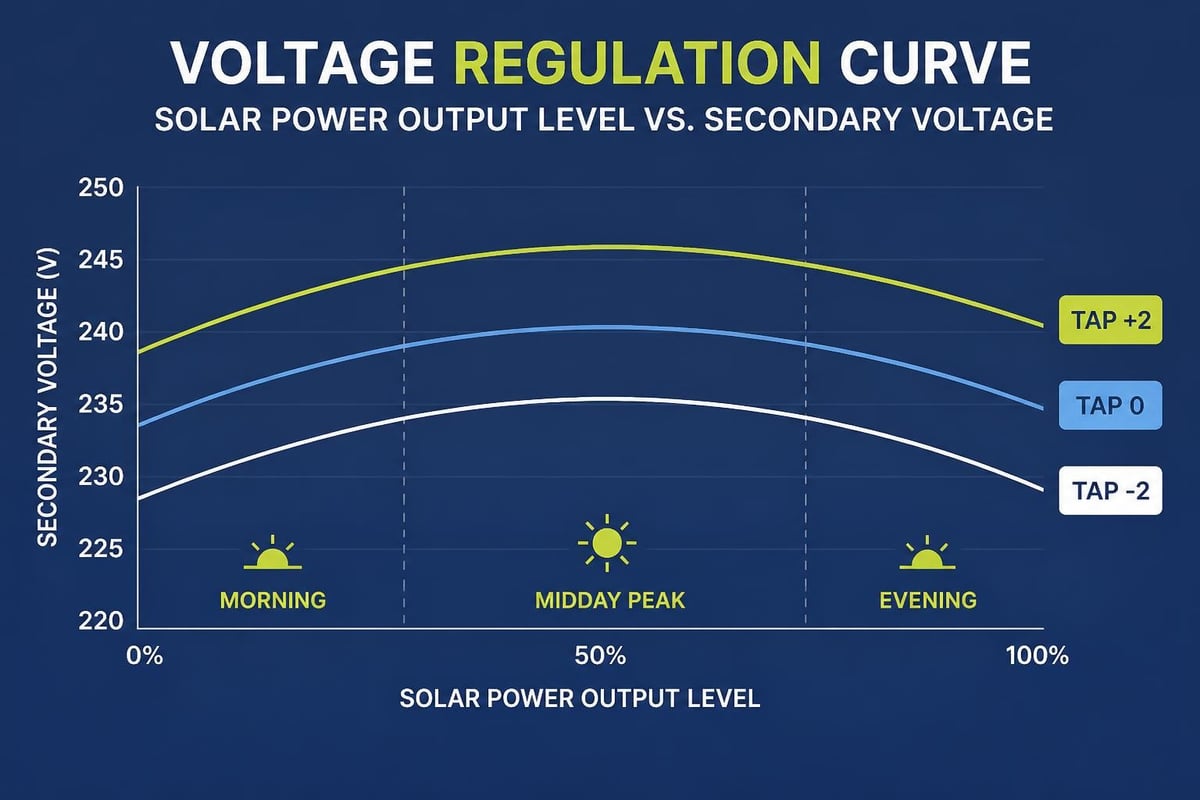
The CIGRE guidance on optimizing transformer performance in renewable-powered grids addresses these considerations specifically for photovoltaic applications, including tap changer settings and voltage control strategies.
Protection and Safety Considerations
Reliable protection systems safeguard both the solar power transformer and connected equipment from fault conditions, overloads, and environmental hazards. A comprehensive protection scheme integrates multiple layers of monitoring and disconnection.
Essential Protection Devices
Every solar transformer installation requires coordinated protection addressing electrical, thermal, and mechanical stress:
- Overcurrent protection via circuit breakers or fuses sized to transformer rating
- Differential protection for internal fault detection on larger units
- Buchholz relay (oil-filled units) detecting gas generation from internal arcing
- Temperature monitoring with alarm and trip functions
- Surge arresters on both primary and secondary windings
- Ground fault detection with directional sensitivity
Medium-voltage installations must comply with utility interconnection requirements, which often mandate specific protection schemes and settings. The UL standards for distributed energy interconnection provide comprehensive testing and certification requirements ensuring safe grid integration.
Grounding and Bonding
Proper grounding establishes a low-impedance path for fault currents while maintaining equipment at safe potential. The solar power transformer grounding system connects to the overall site grounding network, including:
- Transformer tank and enclosure bonding to ground grid
- Neutral point grounding (solidly grounded, resistance grounded, or ungrounded based on system design)
- Lightning protection system integration
- PV array frame grounding coordination
Ground resistance should not exceed 1 ohm for medium-voltage installations, often requiring extensive ground grid systems in rocky or sandy soils typical of South African solar sites.
Installation and Commissioning Best Practices
Successful solar power transformer deployment requires careful planning, proper handling, and thorough testing before energization. Even minor installation errors can lead to performance issues or premature failure.
Site Preparation
Foundation design must support the transformer's weight (ranging from several hundred kilograms for small dry-type units to tens of tons for large oil-filled transformers) while providing drainage and access for maintenance. Concrete pads should extend beyond the transformer footprint with proper slope for water runoff.
Environmental considerations include:
- Minimum clearances for ventilation and heat dissipation
- Protection from direct sunlight (shade structures for dry-type units)
- Flood risk assessment and elevation requirements
- Security fencing with appropriate access gates
- Fire barriers between transformer and other equipment
Outdoor installations face temperature extremes in South African climates. Transformers rated for 40°C ambient may require derating or enhanced cooling in regions experiencing sustained temperatures above this threshold.
Connection and Testing Protocol
Before energizing, conduct comprehensive testing to verify proper installation and identify potential issues:
Pre-energization tests:
- Insulation resistance (megger test) on all windings
- Turns ratio verification across all taps
- Polarity and phase relationship confirmation
- Grounding system continuity and resistance
- Protection relay calibration and functional testing
- Oil quality analysis (dielectric strength, moisture content, dissolved gas)
Document all test results as baseline data for future diagnostic comparisons. Many transformer failures can be predicted through trending of key parameters over time.
Inverter Coordination
The solar power transformer must be energized in coordination with inverter startup sequences. Modern grid-tied inverters require stable voltage at their AC terminals before beginning power production. Establishing proper energization procedures prevents nuisance trips and equipment stress:
- Energize transformer from grid side with inverters isolated
- Verify secondary voltage and phase rotation
- Enable inverters sequentially rather than simultaneously
- Monitor inrush current and harmonic content during initial operation
- Confirm reactive power control functions properly
Systems incorporating hybrid inverters require additional attention to battery charging coordination and backup power transfer logic to ensure seamless operation during grid disturbances.
Maintenance and Lifecycle Management
Regular maintenance extends solar power transformer life while maintaining efficiency and reliability. Establishing a comprehensive maintenance program from the outset prevents costly failures and maximizes return on investment.
Oil-Filled Transformer Maintenance
Annual oil testing provides critical insight into transformer health. Dissolved gas analysis (DGA) detects incipient faults before they cause catastrophic failure. Key indicators include:
| Gas Component | Source | Warning Threshold |
|---|---|---|
| Hydrogen (H₂) | Corona, arcing | >100 ppm |
| Methane (CH₄) | Low-temperature thermal fault | >120 ppm |
| Ethane (C₂H₆) | Medium-temperature thermal fault | >65 ppm |
| Ethylene (C₂H₄) | High-temperature thermal fault | >50 ppm |
| Acetylene (C₂H₂) | Arcing, sparking | >3 ppm |
Oil quality parameters including dielectric strength, moisture content, acidity, and interfacial tension should be monitored alongside DGA to build a complete picture of transformer condition.
Thermographic surveys identify hot spots indicating cooling system problems, connection issues, or internal faults. Performing infrared scans during peak generation captures thermal behavior under maximum load.
Dry-Type Transformer Care
While dry-type units require less intensive maintenance, regular inspection remains essential:
- Quarterly visual inspection for dust accumulation, discoloration, or physical damage
- Annual electrical testing (insulation resistance, turns ratio)
- Cleaning of ventilation paths and cooling surfaces
- Torque verification of all bolted connections
- Ambient temperature and ventilation monitoring
Environmental contamination poses particular risk to dry-type transformers. Coastal installations face salt spray exposure, while agricultural areas deal with airborne dust and chemicals. Regular cleaning prevents insulation degradation.
Performance Monitoring
Continuous monitoring systems track transformer operating parameters in real-time, enabling predictive maintenance and optimizing performance:
- Load current monitoring validates sizing and identifies overload conditions
- Winding temperature sensors provide early warning of cooling issues
- Bushing power factor testing detects insulation deterioration
- Partial discharge monitoring identifies developing insulation weaknesses
- Tap position indication confirms voltage regulation performance
Modern SCADA systems integrate transformer monitoring with overall solar plant operations, correlating transformer performance with generation profiles and environmental conditions.
Economic Considerations and Total Cost of Ownership
Transformer selection involves balancing capital expense against lifecycle costs including losses, maintenance, and replacement. A comprehensive financial analysis guides optimal decision-making.
Initial Investment Components
The solar power transformer purchase price represents only one element of total installed cost:
Direct costs:
- Transformer unit (40-60% of total)
- Foundation and installation (15-25%)
- Switchgear and protection (15-20%)
- Cables and terminations (5-10%)
- Commissioning and testing (3-5%)
Indirect costs:
- Engineering and design
- Utility interconnection fees
- Permits and inspections
- Project management and contingency
Medium-voltage transformers for solar applications typically cost between R8,000 and R15,000 per kVA installed, with economies of scale favoring larger units. Premium efficiency models command 15-25% price premiums but deliver superior lifecycle value.
Calculating Lifecycle Costs
Energy losses consume significant value over the transformer's 25-30 year service life. A 1,500 kVA unit operating with a 0.35 capacity factor (typical for solar) experiences continuous no-load losses plus variable load losses.
Annual loss cost calculation:
No-load losses: 1,200 W × 8,760 hours = 10,512 kWh/year
Load losses: 10,000 W × (0.35)² × 8,760 hours = 10,737 kWh/year
Total annual loss: 21,249 kWh ≈ R38,000 at R1.80/kWh
Over 25 years at 4% electricity escalation, total loss cost exceeds R1.5 million. High-efficiency transformer premiums of R50,000-R100,000 deliver compelling returns.
Warranty and Service Agreements
Manufacturer warranties typically cover defects for 2-5 years, but extended service agreements provide value through:
- Scheduled maintenance and oil testing
- Priority emergency response
- Spare parts availability
- Performance guarantees
- Retrofit and upgrade options
Companies with established transformer maintenance programs, like those specializing in medium-voltage equipment servicing, offer predictable cost structures and expertise in solar-specific applications.
Regulatory Compliance and Standards
Solar power transformer installations must comply with multiple regulatory frameworks governing electrical equipment safety, grid interconnection, and environmental protection.
South African Regulatory Environment
The South African Bureau of Standards (SABS) enforces compliance with applicable standards, primarily adopted from IEC publications. Key requirements include:
- SANS 780 (IEC 60076 series) for power transformer performance and testing
- SANS 10142-1 for electrical installations in buildings
- Occupational Health and Safety Act requirements for equipment installation
- National Energy Regulator of South Africa (NERSA) grid connection codes
Utility-scale installations interconnecting to Eskom or municipal networks face additional technical requirements specified in the Grid Connection Code for Renewable Power Plants. These address voltage regulation, fault ride-through capability, and protection coordination.
International Standards Application
Even for domestic South African projects, international standards provide valuable guidance:
Design and manufacturing standards:
- IEC 60076 series covering all aspects of power transformers
- IEEE C57 series providing complementary specifications
- IEC 61378 for converter transformers (relevant to large inverter systems)
Testing and certification:
- IEC 60060 for high-voltage testing
- IEEE C57.12.90 for routine and type testing
- UL 1562 for transformer safety certification
Installation and operation:
- IEC 60364 for electrical installation requirements
- IEEE C2 (National Electrical Safety Code) for clearances and grounding
- NFPA 70 (National Electrical Code) for fire safety
Compliance documentation should be maintained throughout the transformer lifecycle, supporting insurance requirements and facilitating equipment transfer or sale.
Selecting, installing, and maintaining the right solar power transformer determines your photovoltaic system's efficiency, reliability, and long-term value. From understanding voltage conversion requirements to implementing comprehensive maintenance programs, every decision impacts performance and return on investment. Whether you're planning a residential backup system or a commercial solar installation, ELECTRICAL4U(PTY)LTD brings over 20 years of experience in transformer solutions, switchgear, and solar integration. Contact our team today to discuss your specific requirements and discover how proper transformer selection optimizes your solar investment.