The electrical contracting industry demands rigorous standards, continuous learning, and proven competence to ensure safe, reliable installations. When you engage te certified electricians, you're partnering with professionals who have demonstrated mastery of electrical codes, safety protocols, and modern installation techniques. Certification serves as the industry's gold standard, separating qualified practitioners from those lacking formal credentials. For both residential homeowners and industrial facility managers in South Africa, understanding what certification means-and why it matters-can be the difference between a safe, compliant installation and costly rework or safety hazards.
What TE Certification Means for Electrical Professionals
TE certification represents a formal recognition that an electrician has met specific training, examination, and experience requirements established by certifying bodies. Unlike basic trade licenses, certification validates an electrician's knowledge of current electrical codes, safety standards, and installation best practices.
Core Components of Electrical Certification
The certification process typically encompasses several critical elements that together ensure professional competence:
- Formal apprenticeship completion with documented hours under licensed supervision
- Comprehensive examination covering electrical theory, code requirements, and practical applications
- Continuing education to maintain current knowledge of code updates and new technologies
- Background verification and proof of experience in specific electrical disciplines
- Safety training aligned with standards such as NFPA 70E electrical safety protocols
Most te certified electricians complete four to five years of combined classroom instruction and on-the-job training before sitting for certification examinations. This extended preparation period ensures they encounter real-world scenarios and develop troubleshooting skills that textbooks alone cannot provide.

Certification Tiers and Specializations
The electrical industry recognizes multiple certification levels, each reflecting different experience thresholds and scope of work:
| Certification Level | Typical Experience | Scope of Work |
|---|---|---|
| Apprentice/Trainee | 0-2 years | Work under direct supervision only |
| Journey-level | 4-5 years | Independent residential and commercial work |
| Master Electrician | 7-10+ years | Design, supervise, and train; sign off on permits |
| Specialty (Solar, Industrial) | Varies | Focused expertise in specific systems |
Journey-level certification qualifies electricians to perform most residential and commercial installations independently. Master certification adds supervisory authority and design responsibility. Specialty certifications in areas like photovoltaic systems, medium-voltage installations, or industrial controls demonstrate focused expertise beyond general electrical work.
Code Compliance and Safety Standards
Electrical codes exist to protect lives and property. Te certified electricians maintain current knowledge of these evolving standards, ensuring every installation meets or exceeds minimum safety requirements.
National and Local Code Requirements
The National Electrical Code (NEC) undergoes updates every three years, introducing new safety measures, installation methods, and technology accommodations. The 2023 NEC, for instance, expanded requirements for arc-fault circuit interrupters (AFCIs) and ground-fault circuit interrupters (GFCIs), mandated specific conduit sizing for electric vehicle charging circuits, and updated grounding electrode system rules.
Certified electricians must:
- Study code updates as part of continuing education requirements
- Apply new standards to both new installations and upgrades
- Interpret local amendments that may exceed national baseline requirements
- Document compliance for inspection and future reference
South African electrical installations follow the SANS 10142-1 wiring code and SANS 10400-XA energy efficiency regulations. While certification frameworks differ between countries, the principle remains constant: certified professionals stay current with mandatory standards.
Safety Protocol Implementation
Beyond code compliance, te certified electricians implement systematic safety practices that protect both workers and building occupants. These practices include proper lockout/tagout procedures, arc flash risk assessment, personal protective equipment selection, and emergency response planning.
Certification programs emphasize hazard recognition and mitigation strategies. Electricians learn to identify potential shock risks, fire hazards, and equipment failures before they cause harm. This proactive approach to safety distinguishes certified professionals from untrained installers who may focus solely on making circuits function without addressing underlying hazards.
Continuing Education and Professional Development
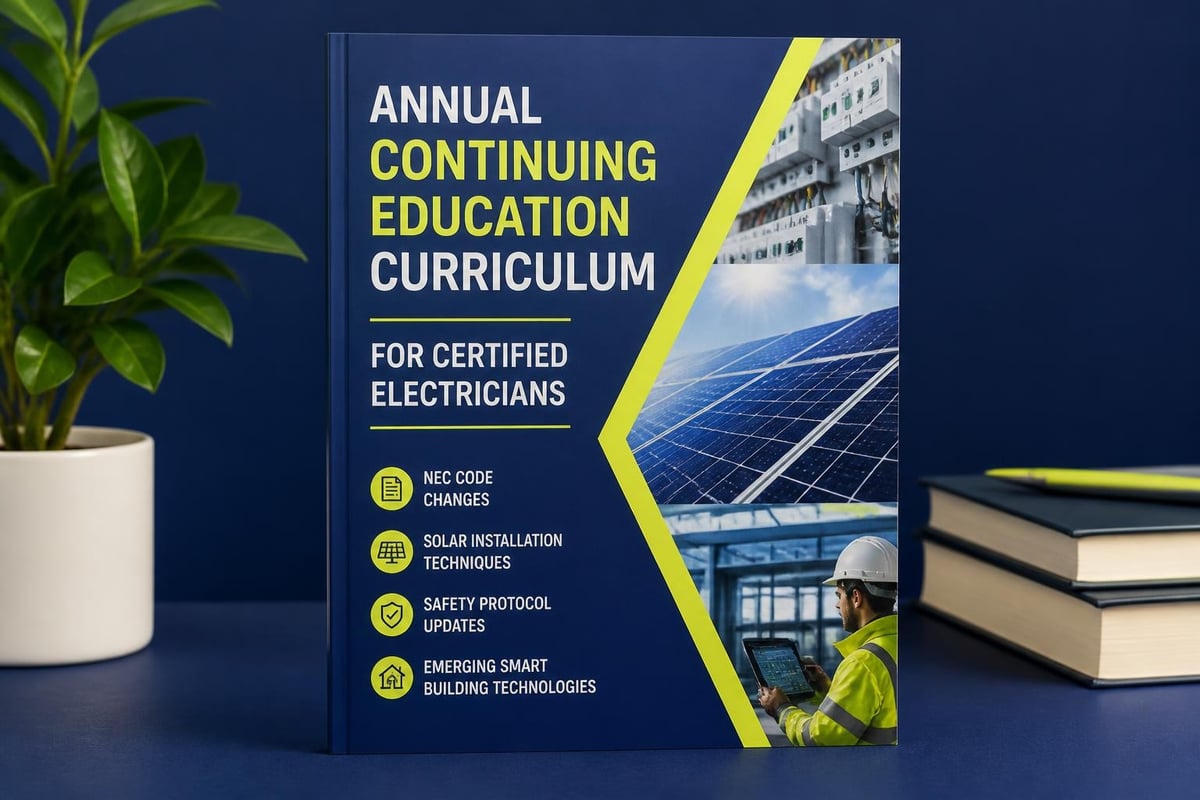
Certification is not a one-time achievement. Maintaining certified status requires ongoing professional development that keeps electricians aligned with industry progress.
Mandatory Training Requirements
Most certification bodies mandate a specific number of continuing education (CE) hours per renewal period-typically 8 to 32 hours every one to three years. California’s electrician certification program, for example, requires 32 hours of continuing education every three years for journey-level and master electricians.
CE topics commonly include:
- Code update seminars covering NEC revisions and local amendments
- New technology training on smart home systems, battery storage, and EV charging
- Safety refreshers addressing arc flash, confined space, and fall protection
- Specialty skills such as fiber optic installation, building automation, or renewable energy systems
Organizations like the Western Electrical Contractors Association provide extensive training catalogs covering code updates, business management, and technical specialties. These structured programs ensure electricians access quality education that meets certification board standards.
International Certification Frameworks
Certification standards vary globally, but share common quality principles. The NICEIC in the United Kingdom maintains comprehensive CPD requirements for registered electrical contractors, emphasizing technical competence, inspection skills, and regulatory knowledge.
These international frameworks demonstrate that professional certification serves a universal purpose: ensuring electricians possess current knowledge and proven skills regardless of geographic market. Te certified electricians who understand multiple certification schemes can more easily adapt to international projects and cross-border standards.
Specialized Certifications for Modern Electrical Work
As electrical systems grow more complex, specialized certifications help electricians demonstrate expertise in specific domains beyond general wiring.
Solar and Renewable Energy Credentials
Photovoltaic system installation requires knowledge of DC circuits, combiner boxes, rapid shutdown systems, and utility interconnection-topics rarely covered in traditional electrical training. Specialty certifications for solar and renewable energy personnel validate this focused expertise.
Solar-certified electricians understand:
- Array sizing and configuration for optimal energy production
- Battery integration including charge controllers and backup circuits
- Grid-tie vs. off-grid topologies and their respective code requirements
- Monitoring and commissioning procedures specific to PV systems
When specifying equipment like the LUXPOWER 6KW HYBRID INVERTER, certified solar electricians ensure proper DC input configuration, battery compatibility, and grid synchronization. This inverter supports dual MPPT inputs for optimized solar harvesting and can scale to 16 units in parallel-configurations that demand thorough understanding of paralleling, load sharing, and safety interlocks.

Industrial and Medium-Voltage Qualifications
Industrial facilities operate electrical systems far exceeding residential complexity. Medium-voltage switchgear, transformer maintenance, motor control centers, and programmable logic controllers require specialized knowledge that general certification doesn't address.
Industrial electricians often pursue additional credentials in:
- Medium-voltage systems (above 600V) including arc flash calculation and equipment testing
- Programmable controllers (PLCs) and industrial networking protocols
- Variable frequency drives for motor control and energy efficiency
- Hazardous location installations meeting NEC Article 500 requirements
These specializations ensure te certified electricians working on industrial projects understand the unique hazards, equipment specifications, and maintenance protocols that keep complex facilities operating safely and efficiently.
Verification and Quality Assurance
Certification provides customers with a verifiable credential that confirms an electrician's qualifications. This verification process protects consumers and elevates industry standards.
Checking Certification Status
Reputable certification bodies maintain public databases where customers can verify current credentials. Before engaging an electrician, facility managers and homeowners should:
- Request certification numbers and issuing authority information
- Verify online through the certifying body's database
- Check expiration dates to ensure credentials remain current
- Confirm specialty endorsements if project requires specific expertise
The California DLSE maintains an electrician certification FAQ that explains how to verify credentials, understand certification categories, and confirm continuing education compliance. While this specific database covers California, it illustrates the transparency standards that reputable certification programs provide worldwide.
Insurance and Liability Considerations
Certification status often influences insurance coverage and liability allocation. Many professional liability and general liability policies offer preferential rates for certified electricians, recognizing that formal credentials correlate with lower risk profiles.
| Insurance Factor | Impact of Certification |
|---|---|
| Premium rates | 10-25% lower for certified professionals |
| Coverage limits | Higher limits available with certification proof |
| Claims processing | Faster resolution when credentials documented |
| Subcontractor requirements | Many GCs require certification for approved vendor lists |
Building owners and general contractors increasingly specify certified electricians in their project requirements, both to ensure quality workmanship and to satisfy their own insurance obligations. This market pressure creates competitive advantage for te certified electricians and firms that employ them.
Business and Career Advantages
Certification delivers tangible benefits beyond regulatory compliance. Both individual electricians and electrical contracting firms gain competitive advantages through formal credentials.
Career Progression and Earning Potential
Certified electricians command higher wages than their non-certified counterparts. Industry surveys consistently show 15-30% wage premiums for journey-level certification and 40-60% premiums for master certification compared to unlicensed electricians.
Career pathways expand with certification:
- Supervisory roles managing project teams and apprentices
- Estimating positions requiring code knowledge for accurate bids
- Inspection careers with municipalities and third-party agencies
- Training roles teaching the next generation of electricians
- Entrepreneurship launching electrical contracting firms with proper credentials
These opportunities remain largely inaccessible to non-certified individuals, regardless of their practical experience. Certification opens doors that experience alone cannot.
Company Reputation and Client Confidence
Electrical contracting firms that employ te certified electricians build stronger reputations and win more contracts. Certification serves as third-party validation of technical competence, reassuring clients that their projects will meet code requirements and perform as specified.
Marketing advantages include:
- Credentials in proposals that differentiate your firm from competitors
- Higher project values as clients recognize expertise justifies premium rates
- Reduced callbacks because certified work typically has fewer defects
- Referral generation from satisfied clients who trust certified professionals
Companies like ELECTRICAL4U leverage their certified staff and two decades of experience to deliver complex projects-from medium-voltage switchgear to solar installations-with confidence that comes from proven credentials and systematic quality control.
Selecting Certified Electricians for Your Project
Whether planning a residential renovation or an industrial facility upgrade, choosing te certified electricians requires evaluating several factors beyond just certification status.
Questions to Ask Before Hiring
Start your electrician selection process with targeted questions that reveal both credentials and practical competence:
- What certification level do you hold, and who issued it?
- When does your current certification expire?
- Have you completed projects similar to mine in scale and complexity?
- What continuing education have you completed in the past year?
- Do you carry current general liability and workers' compensation insurance?
- Can you provide customer references from recent similar projects?
These questions help you assess whether an electrician possesses both formal credentials and relevant experience. The best candidate combines current certification with a proven track record in your specific project type.
Project Scope Matching
Different electrical projects demand different certification levels and specializations. A simple residential outlet addition requires less expertise than a three-phase commercial service upgrade or a grid-tied solar array.
Match your project to appropriate certification:
| Project Type | Recommended Certification | Additional Considerations |
|---|---|---|
| Basic residential repairs | Journey-level | Verify insurance and references |
| Whole-house rewires | Journey or Master-level | Confirm permit pulling authority |
| Commercial tenant improvements | Master-level | Check commercial experience portfolio |
| Solar installations | Solar + electrical certification | Review inverter brands and battery expertise |
| Industrial maintenance | Master + industrial specialty | Verify medium-voltage qualifications if applicable |
For large or complex projects, request a site visit and written proposal that details the specific te certified electricians who will perform the work. Ensure the certified professional actually performs the work rather than delegating to uncertified assistants.
Industry Standards and Regulatory Oversight
Certification programs operate within broader regulatory frameworks that protect public safety through licensing, inspection, and enforcement.
State and Municipal Requirements
Most jurisdictions separate licensing from certification. Licensing grants legal authority to perform electrical work for compensation, while certification validates technical competence. Some regions require both; others accept certification as proof of qualification for licensing.
Understanding your local regulatory environment helps you:
- Verify compliance with both licensing and certification mandates
- Ensure permit validity by confirming electrician authority to pull permits
- Protect yourself legally from liability associated with unlicensed work
- Access inspection services that verify installation quality
Municipalities often maintain lists of approved electricians who hold proper credentials. Consulting these lists before hiring provides additional assurance of regulatory compliance.
Third-Party Certification Bodies
Multiple organizations offer electrician certification, each with distinct standards and recognition:
- National certification programs recognized across state/provincial boundaries
- State-specific certifications meeting local regulatory requirements
- Trade association credentials offered by industry groups and unions
- Manufacturer certifications for specific equipment or systems
When evaluating te certified electricians, understand which certification body issued their credentials and whether that body maintains meaningful standards. Reputable programs require examinations, experience verification, and continuing education-not just payment of fees.
The Value Proposition of Certification
Ultimately, electrical certification creates value for all stakeholders: building owners receive safer installations, electricians gain career opportunities, and the industry maintains professional standards.
Risk Mitigation Through Professional Standards
Electrical failures cause thousands of fires annually, resulting in property damage, injuries, and fatalities. Faulty wiring accounts for a significant percentage of residential fires. Te certified electricians reduce these risks through:
- Proper conductor sizing that prevents overheating and insulation breakdown
- Correct overcurrent protection that interrupts faults before fires start
- Grounding and bonding that safely dissipates fault currents
- Arc fault protection in circuits serving living areas
- Regular inspection and testing that identifies degradation before failure
These fundamental practices, mandated by electrical codes and emphasized in certification training, prevent the majority of electrical-related incidents. The modest premium for certified work represents extraordinary value compared to the cost of electrical fires or shock injuries.
Long-Term Performance and Maintenance
Electrical systems installed by te certified electricians typically deliver better long-term performance with fewer maintenance interventions. Proper installation techniques-correct torque on terminations, appropriate wire management, suitable environmental protection-extend equipment life and reduce failure rates.
Benefits realized over system lifetime include:
- Lower maintenance costs due to fewer component failures
- Reduced downtime in commercial and industrial applications
- Energy efficiency from properly sized and configured systems
- Easier troubleshooting when problems do arise, thanks to code-compliant installations
- Higher resale value for properties with documented, certified electrical work
Forward-thinking property owners recognize that certified electrical work delivers return on investment through decades of reliable service. The initial cost differential fades quickly when compared against the lifecycle value.
Choosing te certified electricians ensures your electrical projects meet rigorous safety standards, comply with current codes, and deliver reliable long-term performance. Certification represents a verified commitment to professional excellence that protects your investment. Whether you're planning residential solar integration, industrial facility upgrades, or medium-voltage installations, ELECTRICAL4U brings over 20 years of certified expertise to deliver electrical solutions that exceed expectations. Contact our team today to discuss how our certified professionals can support your next electrical project with the quality and reliability your facility deserves.